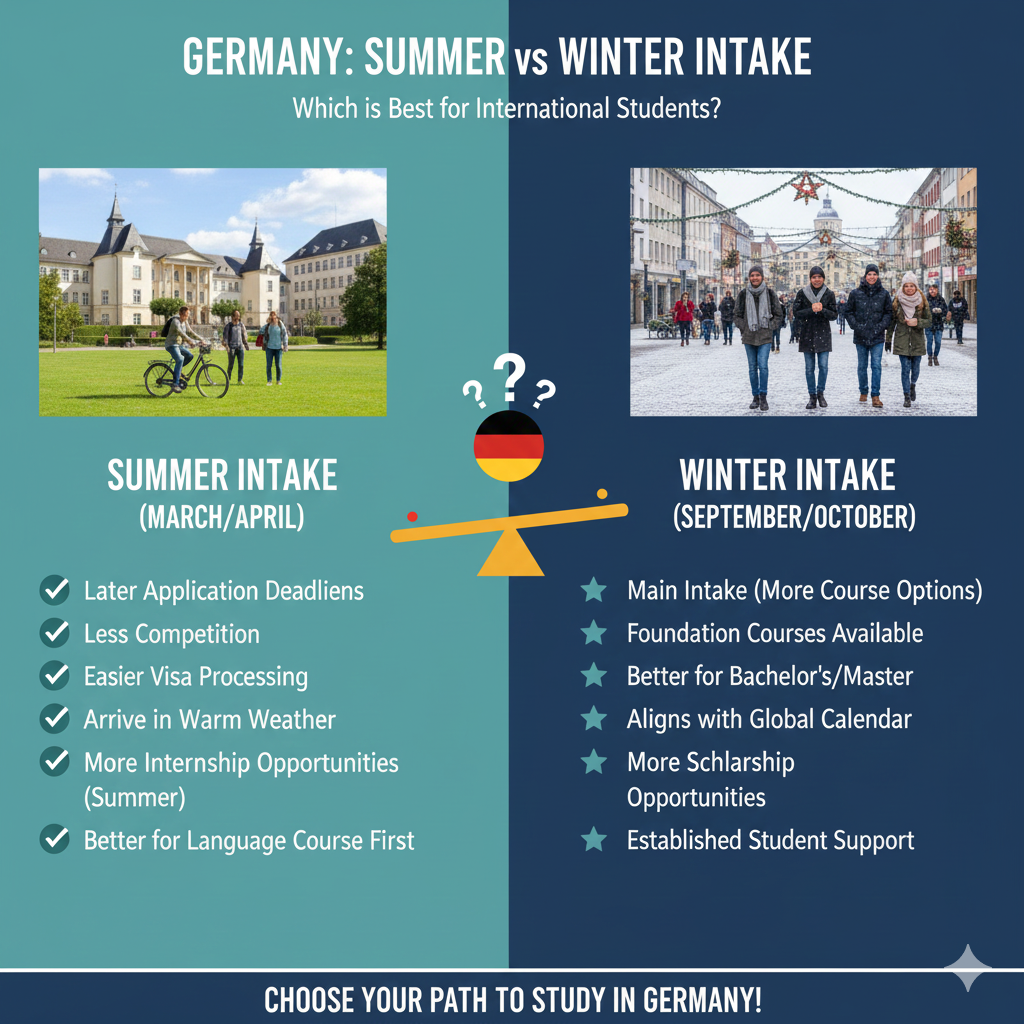
Students getting ready for Germany usually spend a lot of time weighing up the two main intakes, summer, which kicks off around March or April, and winter in October. Both work fine, but honestly, winter ends up being the default for most international folks because there’s just more on offer and it fits better with how things run. As education consultants helping people navigate German unis, we see the decision boil down to what courses are open, how much time you’ve got, and your own circumstances. Let me lay out the main differences in a straightforward way.
How Many Courses You Actually Get to Choose From
Winter intake is the big one. Pretty much every bachelor’s, master’s, and even PhD program at public universities starts then. Whether you’re into engineering, computer science, business, medicine, arts, it’s all there.
Summer is a lot smaller. You’ll mostly find master’s programs, and often only specific ones or continuations. Not every university or department bothers with summer starts, so if you’re beginning a new degree, choices feel pretty restricted.
How Tough It Is to Get a Spot
Winter pulls in the crowds, way more applicants, especially for popular fields like mechanical engineering or data science. Competition gets stiff.
Summer is quieter. Fewer people apply, processing moves faster, and your odds go up a bit if your profile matches. It’s a solid Plan B if winter deadlines slipped past you.
Weather When You First Land
Coming for winter means arriving as autumn fades, days get short, rain picks up, temperatures drop fast. Classes start straight away, so settling in while wrapping up warm can feel a bit rough.
Summer arrival is nicer, spring vibes, mild temps, everything green and bright. You’ve got more daylight to sort housing, explore the city, and ease into things before proper summer heat hits.
How It Lines Up With Jobs and Internships
Winter starters sync better with company hiring cycles. Lots of internships and entry-level roles open up in summer, right after you’ve finished key modules.
Summer folks might find the timing a little off for peak internship seasons, but part-time student jobs are around all year anyway.
How Much Time You’ve Got to Prepare
Winter deadlines are kinder on time, applications for October 2026 usually close May to July 2026 (restricted programs earlier). Gives you breathing room for transcripts, language certs, visa, blocked account.
Deadline for summer applications goes by very fast, the majority of them being finished between December 2025 and mid-January 2026 for April admission. It is a little bit harsh if you start your preparations today.
So Which One Makes More Sense?
Winter fits the majority of the full course range, bigger campus buzz from the start, most scholarships linked to it, and visa offices handle the volume smoothly.
Summer shines if you want lower competition, lovely weather on arrival, or just couldn’t hit winter timings, means you don’t lose a whole year waiting.
There’s no clear winner; it really comes down to your program and how ready you are. Always double-check dates for your exact uni and course, some vary, especially restricted ones like medicine.
If summer sounds good, apply for summer intake in Germany before Deadline 2026 most shut mid-January 2026. For winter, check the deadlines for winter intake in Germany 2026 before applying, It’s likely that the dates will be set for around July 15, 2026, but to be on the safe side, it is better to start the process earlier. For the most recent information, you can check the university websites or DAAD portal as things change slightly with each admission cycle. Choose the option that does not cause any hiccups in your schedule.



Leave a Reply